Henry Philip Dodd’s Grand Tour
While visiting my colleague Jill at her home in Somerset, England, we got to talking about our favorite flea market finds, and she pulled out this old passport she found many years ago. The scans here don’t nearly do it justice, as you don’t get to experience the smell of the cracking old leather case or the onion-skin texture of the fragile old paper, but I still thought it was worth sharing for the musings it sparks.

Physically, I loved it for the handwriting, embossed stamps, and wax seals [!] that came with every point of entry. Official documents used to receive so much more attention to aesthetic detail. Now passports just get some boring, barely legible stamp. Can you imagine getting a calligraphy-like note from an immigration officer in those miserable customs halls in airports now? Hardly. But, nor would women have traveled in sweatpants and Uggs [pet peave] with a rolly bag. People practically deserved a fancy entry on their passport since they were dressed up so nicely to travel, had beautiful luggage in hand, and had arrived on a stylish steamer. No one would dare put a boring stamp on someone’s passport if they’d arrived in such style.
 A Goyard steamer trunk. Now that is traveling in style.
Beyond just the aesthetics of it, I got immensely carried away imagining this man using the passport for all the clues I could possibly gather, Sophie Calle-style, and it lead to some sprawling tangents. It’s amazing how much information about the man and his time can be gathered from one object. This gets long, so if you get bored, just skip to the end. The end idea is worth reading.

click the jump for the rest…
1. Basics: The passport belonged to one Reverend Henry Philip Dodd, and it tracks his travels through Europe in 1854. The first page, shown at the top, unfolds out of the passport and is a sort of letter, that I assume was a standard intro on a passport, from the Earl of Clarendon, letting us know he is from Clarendon, near Salisbury in the south of England. It also notes that he is travelling with his wife, but it doesn’t mention her name. Typical. She probably didn’t even get her own passport. She was just an appendage on his. A nameless appendage. Like a pegleg.
2. Given that he was a reverend and also wealthy enough to travel with his wife, I think it is safe to assume firstly, that he had family money, and secondly, that he was a younger son in his family since the oldest son would have taken over the family estate, another son would’ve been directed into a profession, another son into the military, and finally the youngest sons into the clergy.

3. All of the stops are consecutive – it is one long journey and he doesn’t seem to reenter England between stops, but rather just hops from one destination to the next. One thing, among many, that is so neat about this old passport, is that it notes every city he goes to, not just countries, making the details of his journey much easier to imagine. I would suppose that this was because he was travelling by ship and train, and these defined ports of entry allowed easier tracking of travellers than is possible now with all of our possible modes of transportation.
All of that to say, he was most likely on a “Grand Gour” – the old tradition of upper class Brits, and later Americans, to tour Europe after graduating from university, “In search of,” as the NYT notes, “art, culture, and the roots of Western civilization. With nearly unlimited funds, aristocratic connections and months or years to roam, they commissioned paintings, perfected their language skills and mingled with the upper crust of the Continent.”
I’ve always been fascinated by the idea of the Grand Tour, and I found it interesting that the wikipedia entry notes that the “Grand Tour had more than superficial cultural importance; as [historian] E.P. Thompson stated, ‘ruling-class control in the 18th century was located primarily in a cultural hegemony, and only secondarily in an expression of economic or physical power.’” In the same way that today the upper-class maintains power through the cyclical principle of “it’s not what you know, it’s who you know,” during the era of the Grand Tour, the gentry maintained a their “ruling-class control” through cultural power partially acquired through the education provided by such travel.

4. From Google, I learned that our Reverend Dodd published a book! The Epigrammists. Essentially, it is a collection of epigrams from throughout history. So Dodd was poetry lover!
His introduction on epigrams is very well written:

We translated a lot of epigrams in a Latin literature class in high school, and I found one of my favorites included in his Latin chapter – “A Well-Spent Life” by Martial.

The more I learned about Dodd, the more interested I became. From the page of the passport below, we learn that he stopped in Chiavenna, on the border of Italy and Switzerland.

So I looked up Chiavenna. Don’t you want to go there? Which brings me to my ultimate daydream that stemmed from all of this… Wouldn’t it be cool to take his passport and re-trace his journey and document it? Going from place to place on the same days of the year that he did, so that even the weather would be similar? And to do more research beforehand to figure out how he likely would have gotten from place to place – train? Boat? And to go according to the same means?

And maybe to trace his family history and find out where his descendants are today, and show them the documentation of the trip after it’s all over? They might have never known he went on this trip! If someone found me and told me they’d found my great-great-grandfather’s passport and retraced his travels? …Whoa. So cool.
Ray Charles: Modern Sounds in Country and Western Music

I can never get enough Ray Charles, and at the moment I’m loving this album, “Modern Sounds in Country and Western Music,” originally recorded in 1962, of his versions of classic country songs. Since I happen to also be a fan of classic country, I love knowing that Charles was a fan too and appreciated Nashville songwriting. It’s so cool hearing his vocals and arrangements on these songs!
Oaxaca
 One of the projects we’re working on at the moment is a sixty-room hotel San Miguel, Mexico, and we want to use traditional, regionally-made rugs, so we went to Oaxaca, the textile center of Mexico, to source them.
 As you can see in the photos, Oaxaca is beautiful! The photos above are near the town center, where we stayed, and the photo below is out in the country, where we drove to meet the rug producers. I couldn’t get over the big, open sky and the mountains in the distance.

These are the actual looms that will be used to weave the rugs for our hotel!

Click the jump for the rest…
Each rug takes nine months to produce because the looms are operated by foot-pedals, and the pedals are calibrated to one specific person’s weight, so each rug is woven start to finish by one person. If they get sick for a week, too bad. The rug will wait. There’s something I love about that, in our age of internet and machines and expedited shipping.
The hotel operators, however, do not love that. In fact, they really don’t get why we are using rugs that take nine months to make when we could just get them from like, Pottery Barn, in a couple of weeks. Alas, we think it’s worth it. These rugs have a life and a story.

Here is Pantaleone, who runs the company, showing us how crushing the mold that grows on the cactus in their courtyard produces this richly hued berry color. They use it as one of their dyes! He then squeezed a lime into his hand and the acid turned the mixture bright orange!

The special cactus with its fancy mold…

Pantaleone showing us the various plants, like indigo and lavender, that they use for dyes. SO cool! Not many rug producers still use all natural dyes.

The resulting yarn colors, below. Also, on the left, that is the thing used to spin the raw wool into thread. We saw his mom doing it! Too bad I took those pics on someone else’s camera since all I had was my iphone…
Speaking of his mom, the whole company is basically just made up of his family members. The other rug producers we met with were also family operations– it really is still a traditional, artisinal craft down there! Handed down through the family…

After learning all about the process, we went through piles of designs he has done and came up with our own designs! We used motifs that he uses, but altered the scale or patterns slightly, selected colors that would match our decor, added borders and tassels, and voila! Rugs! Well, nine months from now…


Autumnal Kitchens pt. II
The Suzanne Kasler book arrived today, and she had two autumnal looking kitchens I couldn’t resist adding to the list…


Autumnal Kitchens
Kitchens that suit the current changes in the weather and welcome the new scents and colors of fall seem to either incorporate warm wood tones or a nice big fireplace! Here are a few I wouldn’t mind cooking up some banana bread in…


Curated by:
Eliza Coleman
Section:
Interiors
Labels:
Fall, fireplaces, kitchens, wood
Fall LustList
 Fall has got me daydreaming about cozy textures, warm neutral colors, and retro styling. Well ok, I always love retro styling, but don’t you think fall carries a particular nostalgia? Something about the crisp cool air, back to school clothes, football games, and the promise of apple and pumpkin desserts has a wonderfully nostalgic feel to it. So here are a few things on my wishlist at the moment…
 One of these, please. Aren’t they just the picture of cozy textures and warm neutrals?
 These shoes by Cole, Rood & Haan. A wonderful interpretation of the old preppy classic.

This wool herringbone throw by good old American standby Pendleton. And this buffalo check weekender bag by them as well:

 Arte Italica’s beautiful, yet sturdy and down-to-earth pewter-rimmed pottery. They have just the right look to dress up the comfort foods of fall.

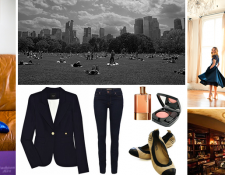
All of it, shoes to lipstick. Via the Sartorialist. I love the heavy texture of the jacket paired with bare legs.
 The fabulously retro looking Olympus Micro Four Thirds or Panasonic DMC-LX3, for snapping all the fabulous fall colors and holiday moments.

With this cute leather carrying case:
And, lastly, a pretty little means of gettin around town. The Betty Foy bike for ladies.


Guerilla Gardening and More


Much of Toronto street artist Posterchild‘s work is right up my alley. Pun not intended, but incidentally much of his work does occur in alleys and other dark, underutilized, or ignored niches of his city. As he describes on his website, he began as a graffiti artist but never felt like he fit into that world. Gradually, he became engaged by the idea that “Authority over the visual landscapes of our cities has been placed out of reach to the very people who live in them,” and his work aims to benevolently “involve himself in these shared public areas” in a way that “challenges the status quo.”
I particularly like the fact that the ones below are planted in flyer bins that have graffiti on them… it makes the evolution of his work pretty ironic. In a good way! 

I LOVE the idea of these “guerilla gardens” he has planted in flyer and newspaper boxes, which certainly qualify is Random Acts of Creativity. There is no heavy handed message whatsoever, and yet the effect of the unexpected burst of beauty physically integrated into a standard object of a gritty urban landscape, an object so seemingly intrinsic to the landscape that it merges into the subconscious and is no longer noticed, does serve as a catalyst for myriad reflections on the urban landscape, from issues of who creates it to how its constant stimuli affect us.

 It also, to me, sends a subtle and hopeful message of empowerment. Not in any kind of revolutionary way, but just the idea that one person can make a street corner more beautiful, and that hundreds of people a day will notice it, is a happy one to me.

This little disco dance club scene inside of a newspaper stand is pretty clever as well… I may be speaking too broadly here in saying “we,” but I personally think we never give up the idea of magic, and happening upon something like this at night would somehow make me feel like there really is magic in the world. Not in the Harry Potter sense, but in the sense that there is still wonder in the world. That you would see this thing, that has no apparent purpose, but that makes you smile and you may never know who did it or why.

I wrote my whole college thesis on the role of art and artists in the world, so I could go on and on about this, but for me, artists who create these kinds of Random Acts of Creativity are important to me for the sense of magic, or wonder, that they keep alive in our ever-increasingly cynical world.
Another example of his urban installations… a pretty fantastic use of a boarded up abandoned building.


As a final note, his work reminds me of one of Sophie Calle’s pieces. She once chose a telephone booth in TriBeCa and cleaned it up and for a week stocked it with flowers, sodas, snacks, a notepad, pens, etc….
 Love that.
Missed Connections
 “You had a guitar. I had a blue hat. We exchanged glances and smiles on the subway platform. I pretended to read my New Yorker, but I couldn’t concentrate. You got on the Q and I stayed to wait for the B. You were lovely.”
I love reading the missed connections on craigslist and other sites, thinking about how people really do sometimes believe in the fleeting eye contact they shared with a stranger, or believe that they understand something about someone simply through their clothes and body language. And I like that missed connections exist for the sole purpose of, well, connecting to another person. They are never malicious.
This blog, where illustrator Sophie Blackall creates illustrations to match missed connections she reads, is so charming.

It inspires many trains of thought for me…
As in the one at the top, I love the little bits of honesty like “but I couldn’t concentrate,” that result from someone putting something anonymously out into the world. Or as in the one below, the tenderness that would never be expressed face-to-face with a stranger. I like knowing that people think such tender things as they walk around in the world.
 “Phoenix w/ crutches: I would like to carry you around piggy back until you can walk again.”
I like that Sophie creates art using material that is already out there in the world waiting to be given a visual form. I mean I suppose that process is actually intrinsic to art, but I like that it is emotions and thoughts coming from someone else originally, and she interprets them. It’s interesting that it’s not an introspective or self-centered art. As she says of the missed connections, “Their messages have the lifespan of a butterfly, I’m trying to pin a few of them down.”
It’s also entertaining how people describe themselves. Sometimes the missed connections start off sweet and then the person says something like, “and I was that toned, attractive brunette guy,” and you’re like, “who would read that arrogant statement and want to reestablish the connection?”
…and also thinking about how the way the one person experienced the interaction could be so totally different from the way the other person perceived it. The writer may have thought it was love, and the sought-after may have just been looking off into space and accidentally made eye contact! Who was it that said that no two people will ever experience anything the same way?
 “Remember? Uptown A train. Sunday around 9pm. I was the black dude reading Bukowski’s Post Office. You were reading the Arts and Leisure section. You passed wind rather loudly and started chuckling. I’d like to see you again. The flatulance wasn’t a turn-off.”
Or, as in the case of the one above, maybe one way you know you’re meant to be with someone is that you DO experience things similarly. Maybe this guy was the only other person on the train that thought it was funny that this girl passed gas and then chuckled at it, and he knew they were soul mates!
Curated by:
Eliza Coleman
Section:
Random Acts of Creativity, Sentimentalism
Labels:
illustration
Random Acts of Creativity >> Office Romance
This one isn’t necessarily random, but I still love it. I love that it is about love expressing itself through creative means. This is the kind of love I would like. How many times did I just say love? Five.
Love it! Six.
Random Acts of Creativity


As I’ve said before, I love the movie Amelie, and really, I love the whole idea of acts of random creativity. I just coined that phrase, by the way. So naturally, I think this is awesome. These two people decided to write an individualized letter to everyone in the small Irish town of Cushendall, just to see what kind of interactions and conversations it would spark amongst neighbors. It’s difficult to describe why precisely, but I find these kinds of things so inspiring. They have no point, really, but nonetheless they make me happy.
Here are a few– it’s pretty interesting to read them and see what they thought of to say to total strangers. You can see all of them here.

It’s the same reason that I love French conceptual artist Sophie Calle, who I discovered at the Venice Biennale a couple of years ago in the most clever exhibit I’ve ever seen.
Her projects are more introspective than they are aimed at affecting others, but interesting in their explorations just the same. For example, she once found an address book on the sidewalk and called all the numbers in it to interview them about the address book’s owner, and then published the piece as an article in the newpaper.
I’ll just copy an article from the Guardian that can describe her work, including the genius biennale exhibit, better than I can:
He loves me not


Picture this. You’re one of France’s best-known living conceptual artists. You’re 51 and visiting Berlin. Your mobile beeps, it’s an email from your boyfriend. In a hideously self-absorbed message about human emotion, he dumps you electronically, saying it hurts him more than you. He signs off: “Take care of yourself.” You’re heartbroken. Then you think of its potential as art.
Click the jump for the rest of the essay:
Over two years later, she distributed the missive to 107 women professionals, photographed them reading it and invited them to analyse it, according to their job. The ex’s grammar and syntax have been torn apart by a copy editor, his manners rubbished by an etiquette consultant and his lines pored over by Talmudic scholars. He has been re-ordered by a crossword-setter, evaluated by a judge, shot up by a markswoman, second-guessed by a chess player and performed by actress Jeanne Moreau. A forensic psychiatrist decided he was a “twisted manipulator”. The temple to a woman scorned is entitled “Take care of yourself” (Prenez soin de vois), immortalising lines that Calle, if she hadn’t had recourse to the international art world, might have read again and again in tears.
“The idea came to me very quickly, two days after he sent it,” she said. “I showed the email to a close friend asking her how to reply, and she said she’d do this or that. The idea came to me to develop an investigation through various women’s professional vocabulary.”
At first it was therapy; then art took over. “After I month I felt better. There was no suffering. It worked. The project had replaced the man.” She feared he might come back seeking a reconciliation, which would have ruined the whole thing.
Sitting under a pair of stuffed bull’s heads in Calle’s warehouse home south of Paris, surveyed by her taxidermy housemates (a bear in a rocking chair, a tiger in a necklace and a zebra), it’s hard not to wonder what man would send her a monstrous email like this.
He must have known he would be immortalised by French art’s game-player in chief, the Marcel Duchamp of emotional dirty laundry. This is the woman who 30 years ago started her career following and photographing strangers in the street, once trailing a man to Italy. Over a decade before Tracey Emin displayed her soiled sheets, Calle invited strangers to sleep in her bed for eight-hour shifts over nine-days, photographing and asking them what age they were when they last wet the bed.
She got hold of a lost address book, interviewed everyone inside about its owner and published the results in the newspaper Libération, delighted when he sought revenge by publishing a nude photo of her. She got a job as a chambermaid in a Venice hotel to rummage through guests’ possessions and photograph the mess people left.
Calle won’t say who dumped her, only that there is a one-word clue at the start of the book of the exhibition. Did he approve? “He knew about it. He didn’t like the idea, but he respected it. So he decided not to meddle.”
Was she looking for revenge? “No. And a fear that it might be interpreted like that initially made me hesitate.”
She doesn’t use her all boyfriends as work, she insists. Her current partner has asked her not to do anything based on him and she has agreed.
Take Care of Yourself is only her second piece about a partner, she says, if you don’t count No Sex Last Night, a film about marriage made with
her then husband. Her first dumping piece, Exquisite Pain, is to be revisited in a new exhibition with her “guardian angel” Frank Gehry in Luxembourg. It is the record of how in 1985, Calle won a bursary to Japan for three months and her boyfriend arranged to meet her in India at the end. As she was boarding the plane she got a message saying he was in hospital in France. He had actually met someone else. She repeatedly told the story of her dumping, asking others about their worst moments of suffering. She found it too raw to show the piece for almost 20 years, until a Pompidou Centre exhibition in 2003.
Raking through her emotional life for subjects, she has been compared to women artists including Emin and accused of cheap tricks. “Love, life and death – all of that is the most mundane material for artists. It amuses me because people often say, doesn’t it bother you to show your private life? I say, well if you ruled out private life, you would have to eliminate all poetry. Victor Hugo, Baudelaire and Verlaine use their emotional life as subject matter. What I’m putting on show is a dumping. All dumping letters are the same, they’re unpleasant. This one is neither better or worse than all the rest. It’s an aid to a break-up. I don’t talk about the man, and all the better. The subject is the letter, the text … It was the words ‘take care of yourself’. Those words made me click. He said ‘take care of yourself’, he knows how I take care of myself, he knows what my method is.”
Calle’s “method” of dealing with the suffering the world throws at her is to see it all as a game of chance and coincidence, a ritual ripe for exposure on a wall. The daughter of a doctor who collected pop art and a press officer mother, she never went to art school. She keeps no sketchbooks. “Ideas just come to me,” she said. As a teenage left-wing militant she campaigned to legalise abortions and took off to travel the world. When she came back to Paris, aged 26, she began following strangers because she didn’t know what to do with herself. “It was a way to force myself to get out of the house without having to decide what I was doing.”
A prime example of Calle turning pain into art is another piece for the Biennale. Calle says that when she was told last year that she would be showing at Venice, another call came through: her mother saying she had a month to live. Calle nursed her at home. But she had heard that people who are dying often wait for the two minutes when their relatives leave the room to slip away.
“It became almost an obsession. I wanted to be there when she died. I didn’t want to miss her last word, her last smile. As I knew I had to shut my eyes to sleep, because the agony was very long, there were a risk I might not be there. I put a camera there, thinking if she gave a last jump or start, a last word, at least I’d have it on film.”
This led to another fixation. “The obsession of always having a tape in the camera, changing the tape every hour, was so great that instead of counting the minutes left to my mother, I counted the minutes left on each tape.”
Calle was in the room when her mother died. She hadn’t shot the footage as a piece and didn’t feel ready to use it, but her Venice curator persuaded her. “Pas pu saisir la mort” is a film installation of the last minutes of her mother’s life. “I spoke to my mother about the Biennale … She was so horrified about not being there, I thought the only way I can make her be there is if she’s the subject.”
Calle says death is part of her life. As a child she lived on the edge of Montparnasse cemetery in Paris. She would cross it four times a day to and from school, invent families on the tombstones and take them food. Her mother would enact elaborate funeral rituals for her pet goldfish and cats. The view out of her kitchen window is a pseudo-cemetery of funeral plaques she built herself.
Calle will continue to deal with what annoys and hurts her by turning it into a game. Her latest project is spotting mistakes in journalists’ articles about her art. “I thought to myself, maybe there’s material in taking the errors and enacting the works just as they are described by the journalists? So if a journalist mistakenly said I’d done a project with deaf people, I’d have to do a project with deaf people.”
I think about inserting some wild inaccuracies to give her some space for her work. “Before I got irritated and said, ‘it’s not true, I never said that’, I now rub my hands, when I’ve found something wrong. It’s another way of taking care of myself, a way of turning things around. Instead of being upset about being misinterpreted, I go looking for it, I hope for it, I wait for it. It’s the right method, turning things to my advantage in order not to suffer from them.”